




Table of Contents
In an era where electric mobility and energy storage are advancing side by side, lithium batteries have become the core of energy conversion. Whether as traction batteries for vehicles or as storage systems for RVs, boats, and solar systems – they carry the dual responsibility of high energy density and long-term stability. To ensure that these batteries operate safely and reliably in complex environments over the long term, laboratory testing is indispensable.
1. Why Battery Systems Require Strict Laboratory Verification
Lithium batteries may appear stable externally, but internally they contain several potential risks. Each cell consists of cathode and anode materials, electrolyte, and separator – deviations in any part can disrupt the chemical balance and lead to thermal runaway, gas formation, fire, or even explosion.
Overcharging and deep discharge: When the charging voltage exceeds the design limit, the electrolyte decomposes and forms gases; deep discharge can cause copper dissolution at the electrodes and increase the risk of short circuits.
Internal short circuit: Separator tears, foreign-object penetration, or cell swelling can bring the positive and negative terminals into direct contact.
Heat accumulation: With insufficient thermal management, cell temperature rises, side reactions accelerate, heat accumulates, and a vicious cycle develops.
External factors: Vibration, shock, crushing, moisture, or high temperatures can lead to failure during field operation.
These risks are often invisible in daily use. Through laboratory testing, however, they can be simulated and detected early, allowing design adjustments and safety verification before products enter the market.
2. Standardized Tests: International Standards & Regulatory Requirements
Battery testing follows a set of international standards and regulations – they ensure that products operate safely during transport and use:
UN 38.3: UN standard for dangerous goods transport – eight environmental and mechanical tests for lithium batteries.
IEC 62133: Safety standard for rechargeable batteries – verification that no ignition or leakage occurs under normal use and misuse.
IEC 62619: Ensures that batteries operate safely and reliably throughout their entire life cycle under foreseeable use and misuse conditions.
CE/ROHS/REACH: EU conformity for material, design, and environmental safety.
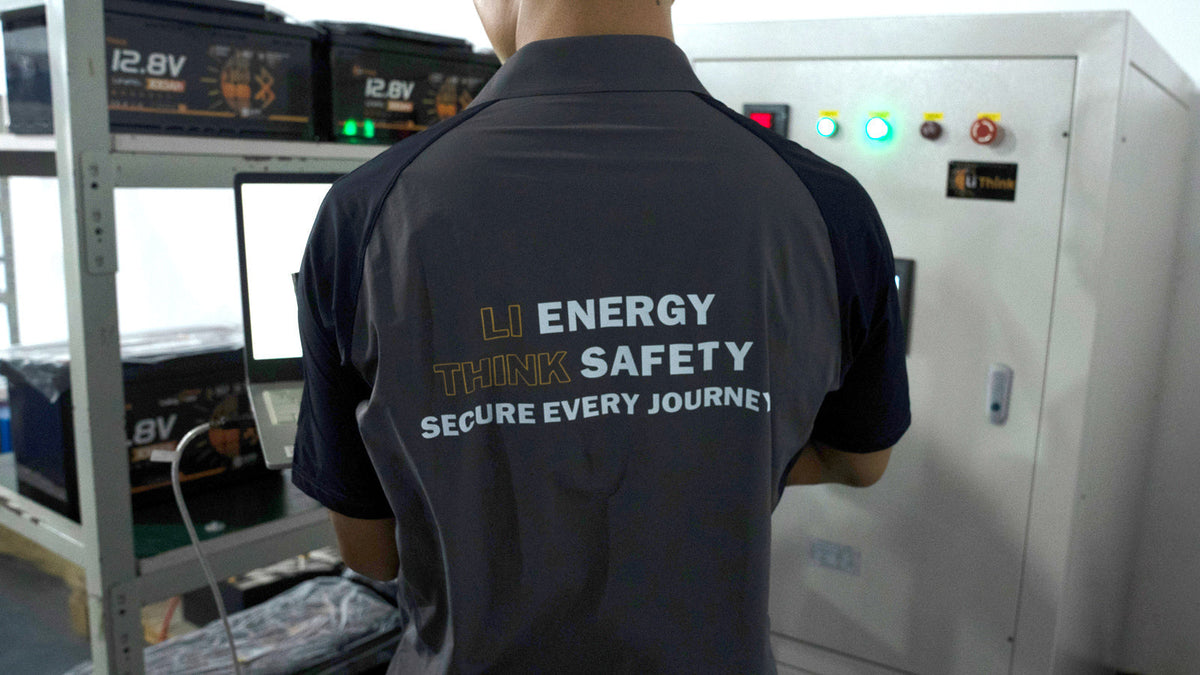
The Lithink laboratory conducts internal quality tests according to international standards and, at the final product stage, also performs packaging and transport drop tests, including 1 m free-fall tests, to ensure that every battery reaches the user safely and undamaged.
3. Real Data: Key Battery Tests
Vibration Test
Frequency range: 7–200 Hz
Acceleration: 1.5 g (sinusoidal) or 3 g (random)
Axes: X, Y, Z, 3 h each
Result: Voltage stable, housing without cracks, connections stable
Mechanical Shock Test
Acceleration: 150 g
Pulse duration: 6 ms
Scope: Three axes, six directions, 18 shocks in total
Result: No cell displacement, no leakage, no abnormal temperature increase
Drop Test
Height: 1 m
Directions: Free fall on six sides
Repetitions: 10
Result: Housing intact, terminals secure, normal function, no structural damage
Crush & Nail Penetration Test
Crush conditions: 13 kN until 30% housing deformation
Nail test: 3 mm steel pin through the cell at 25 mm/s
Result: No fire, no explosion, temperature rise within the safe range, safety valve vents properly
Short-Circuit Test
External resistance: ≤ 50 mΩ
Test temperature: 25 °C
Duration: until voltage < 1 V
Result: Protection circuit disconnects automatically, surface temperature < 50 °C, no leakage/swelling
Charge & Discharge Cycle Test
Cycle conditions: 1C charge / 1C discharge
Number of cycles: 4000
Standard temperature: 25 °C
Result: Capacity retention > 80%, internal resistance increase < 10%, BMS protection functions stable
Temperature & Humidity Chamber
Temperature range: −20 °C to 60 °C
Humidity range: 45–95% RH
Duration: 240 h
Result: Housing without corrosion, label intact, electrical performance without degradation
Salt Spray Test
NaCl concentration: 5%
Temperature: 35 °C
Duration: 48 h
Result: Metal terminals without rust, coating intact, insulation values stable
Transportation Simulation
Standards: UN 38.3 / ISTA 3A
Contents: Random vibration, drop, pressure and temperature changes
Duration: 8 h combined cycle
Result: Structure intact, voltage stable, packaging without deformation/breakage
Thermal Abuse
Heating rate: 5 °C/min
Target temperature: 130 °C
Holding time: 10 min
Result: Safety valve opens normally, no fire/explosion, function normal after cooling
4. Behind the Data: Structural Design & Material Improvements
The value of laboratory data lies not only in passing or failing, but in feedback and optimization. Every temperature curve, every short-circuit response, and every drop test leads to concrete design improvements.
Uneven temperature distribution: Adjust heat conduction paths or add insulation layers.
Delayed overcurrent triggering in the BMS: Optimize measurement paths or adjust MOSFET specifications.
Module loosening in vibration testing: Revise support structure, screw connections, and locking methods.
Through continuous testing and improvement cycles, a product evolves from “functional” to “stably functional” and finally to “long-term reliable.” This validation loop is the heart of the Lithink laboratory system – every data deviation becomes the starting point for the next reliability improvement.
5. The Importance of a Comprehensive Testing System
Battery safety is not a one-time design goal, but the result of a complete verification system. From material selection to delivery, hypotheses must be supported by laboratory testing, weaknesses must be discovered, and structures must be optimized. The laboratory is not only a development center, but also a safety guarantee. Here:
Cells are cyclically charged/discharged: to verify cycle life.
BMS is stressed under extreme temperatures: to validate protection mechanisms.
Housings & brackets are vibrated/shocked: to prove mechanical robustness.
Only these systematic tests ensure that every battery passes the real-world test before reaching the market.
6. Conclusion
From the laboratory to the RV, from the test bench to the user – safety is a path of continuous verification. Laboratory testing not only proves conformity, but also creates transparency, traceability, and continuous improvement in the safety of every individual battery. The goal of testing is not merely passing – but trust.



Share:
Why Lab Tests Are Crucial for Battery Safety