
Table of Contents
With the growing popularity of energy storage systems and new energy applications, the parallel connection of batteries has become an important method for increasing runtime and expanding capacity. Whether for an RV, boat, or home off-grid solar system, correct parallel charging makes energy use more efficient and stable. At the same time, parallel charging also involves risks: incorrect methods can shorten service life or even cause safety issues. This guide explains all key aspects of parallel charging, from basic concepts to practical steps, so you can use this technology safely and efficiently.
1. What Is Parallel Battery Charging?
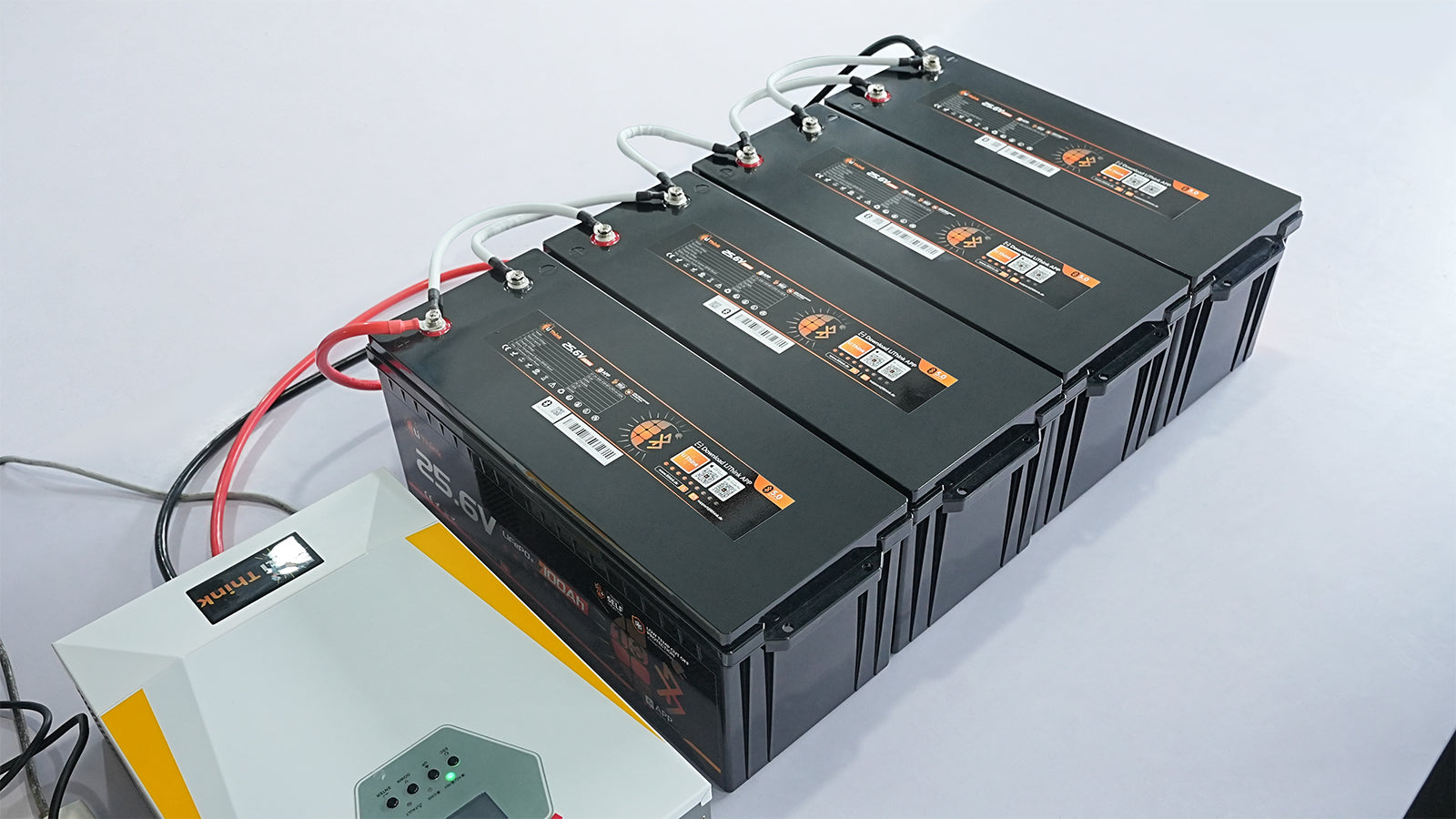
In parallel charging, the positive terminals and negative terminals of multiple batteries are connected together. This creates a battery pack with combined capacity at a constant voltage, which is charged as one unit by a charger.
Example: Two 12 V 100 Ah LiFePO4 batteries connected in parallel remain at 12 V, while the capacity increases to 200 Ah — the total energy doubles. During charging, the charger works at 12 V; the charging current is automatically distributed among the individual batteries.
Compared with series connection where voltage is added while capacity remains the same, parallel connection is suitable when the system voltage should remain unchanged while capacity needs to be significantly increased. For users, this means the system can be expanded easily without changing the inverter or connected devices — ideal for home energy storage and mobile applications.
2. Benefits of Parallel Connection & Suitable Scenarios
Main Benefits
- Increased capacity, longer runtime: The total capacity equals the sum of all individual capacities and noticeably extends power supply time.
- Current sharing, lower stress: Charging and discharging current are distributed across multiple batteries; individual cells heat up less and losses are reduced.
- Flexible expansion, lower cost: No large upfront investment is required — capacity can be expanded step by step through parallel operation.
- Redundancy, higher reliability: If one battery fails, the others can continue working; overall system stability improves.
Suitable Use Cases
- RV travel: High demand from refrigerators, air conditioners, and lighting — parallel connection ensures long-lasting power supply.
- Off-grid solar systems: More reserve capacity for consecutive rainy days — helping avoid power outages.
- Power tools & electric vehicles: Longer range/operating time through capacity expansion.
- Outdoor power & portable power stations: Larger capacities for camping and field work.
Lithink LiFePO4 batteries support multiple parallel connections and are especially suitable for RVs, trolling motors, and off-grid solar applications; they operate stably and help extend system service life.
3. Common Methods for Parallel Charging
Method 1: Direct Parallel Connection — Basic Method
Connect positive to positive and negative to negative — the combined battery group is charged as one pack.
- Advantage: Simple implementation and low cost.
- Disadvantage: Batteries must be identical in model, capacity, internal resistance, and voltage; otherwise, uneven current distribution, shortened service life, or safety risks may occur.
Method 2: CC-CV Charging — Constant Current/Constant Voltage
Charging starts with constant current, then switches to constant voltage after the target voltage is reached; the current decreases until the battery is full.
- Advantage: Safe charging process — especially suitable for lithium batteries.
- Disadvantage: If there are large differences in internal resistance or capacity, individual batteries may be incompletely charged or overcharged.
Method 3: Intelligent Synchronization via BMS
A battery management system monitors voltage, current, and temperature and actively controls branch currents for balanced charging.
- Advantage: Effectively solves inconsistencies and significantly improves service life and safety.
- Disadvantage: Additional hardware cost; commonly used in large storage systems and traction systems.
The Lithink series features an intelligent BMS with voltage monitoring, overcurrent protection, and — depending on the model — a Bluetooth app for displaying voltage and temperature, making parallel operation safer and more reliable.
4. Important Notes for Parallel Charging
Key Requirements
-
Consistency/identity of batteries: Same chemistry, no mixing; same specifications, including capacity in Ah and nominal voltage. Before connecting in parallel, equalize the voltages; at full charge, the open-circuit voltage difference should be < 0.1 V. Keep internal resistance similar; AC internal resistance deviation should be < 10 %. Cable paths for each parallel branch should be the same length and have comparable resistance to minimize external imbalance.
-
Charging current limit: Total charging current ≤ maximum allowed current per individual battery × number of batteries in parallel. Example: Max. 50 A per battery → two in parallel → total ≤ 100 A.
-
Temperature monitoring: Optimal range: 0 – 45 °C. Preheat below 0 °C; stop charging immediately above 50 °C.
-
Charging environment: Ensure good ventilation and avoid moisture and open flames; insufficient heat dissipation may lead to overheating.
-
Preconditioning before first parallel operation: Fully charge all batteries individually and bring them to the same voltage before connection to avoid inrush currents. Tighten terminals carefully to prevent contact problems and heating.
5. Common Mistakes You Should Avoid
- Mixing different battery types: Do not connect lithium and lead-acid batteries in parallel — significantly different electrochemistry can damage the batteries.
- Ignoring aging: Connecting aged, high-resistance batteries in parallel with new ones can lead to overcharging or undercharging of the new batteries.
- Cheap chargers without protection: Lack of overvoltage/overcurrent protection can damage batteries over the long term.
- Excessive fast charging: Very high currents accelerate SEI wear in lithium batteries — service life decreases.
- Connection errors: Loose or oxidized terminals cause heating and may even create a fire risk.
6. Effects of Parallel Charging on Service Life
The effect on service life depends on correct implementation. If done properly, parallel charging does not harm service life: current flows where it is needed, and the overall system operates in a balanced manner.
However, ignoring the consistency rules can cause significant damage:
- Uneven current distribution: Batteries with higher internal resistance receive less charging current but carry more discharge stress — they age faster and worsen the imbalance.
- Internal equalization currents: Even small voltage differences drive equalization currents between batteries when idle — this permanent loss accelerates degradation.
- Local overcharge/deep discharge: In extremely inconsistent groups, one battery becomes full or empty earlier while others continue operating — the affected cell suffers excessively.
Experience/measurement values: With < 5 % internal resistance deviation, parallel lithium battery packs can maintain a cycle life of ≥ 90 % of a single cell; when heterogeneous batteries are mixed, service life may fall to ≤ 60 %.
7. Long-Term Maintenance & Management of Parallel Battery Groups
Even well-configured packs drift apart over time. Without maintenance, performance and safety decline — long-term management is essential.
- Regular checks: Measure voltage, internal resistance, and capacity of each battery every 3–6 months. If significant deviation occurs, maintain or replace individual batteries.
- Balancing charge: Periodically charge for a longer time with low current to bring cell voltages back into alignment and stabilize group performance.
- Storage management: For longer idle periods, keep SoC at 50–70 % and recharge every 1–2 months. Store in a ventilated, dry place at 15–25 °C.
- Usage log: Document charge/discharge cycles, depth of discharge, and abnormalities. If one battery drops noticeably faster after full charge, take action early.
- Fault handling: If swelling, leakage, overheating, or significantly low voltage occurs, immediately isolate the affected battery and do not continue using it in parallel.
8. Summary
Parallel charging is a common and efficient method for capacity expansion. It extends runtime, reduces the stress on individual batteries, and improves system reliability. But parallel connection is more than “just connecting batteries” — it is based on clear electrical principles and safety rules.
Key Points
- Ensure consistency: Same chemistry, same specifications, equalized voltages.
- Control charging current & voltage: Respect system limits.
- Precondition before parallel connection: Equalize the voltages of individual batteries.
- Use protective measures: Plan overcurrent/short-circuit protection.
With the right methods, parallel charging becomes a safe and reliable strategy — for more efficient and more stable battery systems.
Share:
3.6 kWh 12V 280Ah LiFePO4 Battery: Power, Range & Safety
LiFePO4 Battery Temperature Limits & Safe Operating Range