
Table of Contents
In battery use and maintenance, cycle life and depth of discharge (DOD) are two key factors that determine performance and durability — partly due to technical design and partly due to usage habits. A high DOD releases more energy per cycle but accelerates material aging; a low DOD significantly extends service life but reduces the usable capacity per cycle. The goal of this article is to find the right balance point.
1.What Is DOD? Understanding Depth of Discharge
DOD (Depth of Discharge) describes how much a battery is used in one cycle — expressed as the percentage of energy removed relative to the nominal, currently usable capacity.
- 100 % DOD: The battery is discharged from full to nearly empty.
- 50 % DOD: The battery releases half of its capacity and is then stopped.
Example: A healthy 100 Ah battery starts at 90 % SoC and 40 Ah is removed. The DOD is the share of removed energy relative to the total capacity. In this case, the DOD is 40 % based on 100 Ah. Important: The currently available capacity is always the basis for calculation.
Calculation formula: DOD = (removed energy) / (nominal capacity) × 100 %
Example with capacity degradation: If usable capacity drops from 100 Ah to 90 Ah and 40 Ah is removed, then:DOD = 40 / 90 × 100 % ≈ 44.4 % — the current total capacity (90 Ah) is the reference value, not the original rated value.
The higher the DOD, the greater the chemical stress per cycle and the faster aging progresses. Conversely, a low DOD means less stress, slower material fatigue, and therefore significantly more cycles.
2.Cycle Life: A Measure of Battery Robustness
Cycle life is the number of complete charge/discharge cycles until capacity drops to 80 % of its initial value.
- Lead-acid: typically 300–500 cycles (@100 % DOD)
- Li-Ion (NMC/LCO): about 500–1000 cycles (@100 % DOD)
- LiFePO4: 2000–4000 cycles, with high-end models sometimes up to 5000 (@100 % DOD)
Cycle life has an inverse relationship with DOD. Example (Lithink LiFePO4 Battery): At 100 % DOD, at least 5000 cycles are possible; at 70 % DOD, it reaches >8000 cycles; at 40 % DOD, up to 15,000 cycles. With scientifically managed depth of discharge, the service life of the same battery can practically double or more.
3.Why Does DOD Affect Service Life?
The service life of a battery is strongly correlated with depth of discharge. During discharge, physical and chemical processes occur inside the battery, and their intensity increases with DOD:
- Structural damage to electrode materials: Frequent deep discharge causes cyclic swelling/shrinking; crystal lattices can crack and structural integrity decreases.
- Loss of active material: Deep discharges promote irreversible side reactions — some Li-ions are no longer available later.
- Accelerated by-product formation: Under high stress, for example, the SEI layer grows more strongly; ionic conductivity decreases.
- Increase in internal resistance & heat accumulation: Deep discharges increase internal resistance, producing more heat; high temperatures further accelerate electrolyte degradation and electrode aging — a vicious cycle.
At low depth of discharge, cycles are “gentler”: lower mechanical stress, slower by-product formation, lower degradation rates — therefore longer service life. Deep discharge provides more energy in the short term, while shallow discharge provides more years in the long term.
4.High DOD (Deep Discharge) vs. Low DOD (Shallow Discharge)
High DOD (deep discharge)
Advantages:
- Large one-time capacity: maximum use of stored energy; suitable for long runtimes or high loads.
- Less frequent charging when recharging is difficult — better continuity during operation.
Disadvantages:
- Shorter cycle life → higher long-term costs.
- Higher risk of deep discharge/protection shutdown, potentially irreversible damage.
- Higher requirements for thermal management, especially in warm environments.
Low DOD (shallow discharge)
Advantages:
- Significantly more cycles, lower life cycle cost.
- Lower electrochemical stress and high capacity retention over years.
- Ideal for stationary, long-term, or unattended systems.
Disadvantages:
- Less one-time usable capacity → larger battery packs or more frequent charging required.
- With limited budgets or space requirements, the initial investment may be higher.
5.Recommended DOD Ranges by Application
| Application Scenario | Recommended DOD | Core Reason |
|---|---|---|
| Household photovoltaic/home storage | Low (40 %–60 %) | Daily recharging is available; shallow discharge maximizes cycle durability, stable long-term supply, and fewer replacements. |
| Small off-grid systems | Low (40 %–60 %) | Limited capacity and low loads; shallow discharge ensures long-term reliability. |
| Trolling motor (fishing) | High (70 %–90 %) | Maximum runtime per use; even with shorter service life, daily autonomy is maintained. |
| RV – long trips/camping | High (70 %–90 %) | Many loads such as refrigerator, lighting, and heating → high autonomy requirement. |
| RV – short trip/weekend | Low (40 %–60 %) | Lower loads; shallow discharge reduces aging and total cost. |
Note: There is no universal DOD value for every situation. Stationary applications prioritize service life; mobile scenarios prioritize range/endurance.
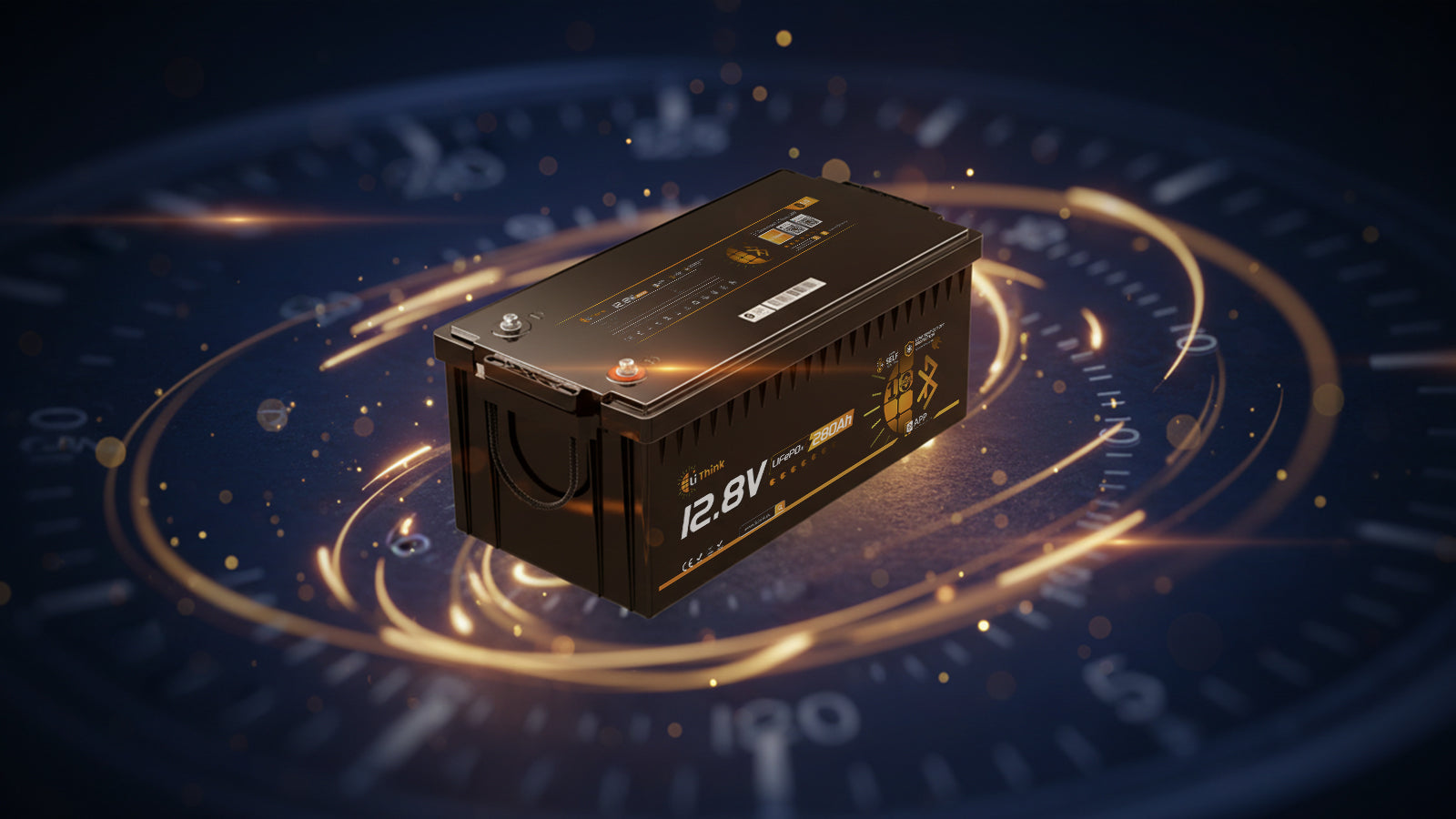
Recommendation: Lithink LiFePO4-batteries deliver 5000+ cycles even at 100 % DOD — enough for >10 years of reliable power supply, with high stability even under heavy loads and long-term operation.
6.Best Usage Strategy: Extend Service Life and Preserve Capacity
-
Maintain moderate DOD
- Avoid frequent 100 % discharges; aim for 50–80 % DOD in daily use.
- This maintains the balance between usable energy and cycle life.
-
Define target DOD by scenario
- Home storage: 40–60 % DOD — low degradation, high stability.
- Trolling/RV: daily target 60–80 %, with deeper discharge allowed for emergencies/peak loads.
- Portable power: Higher DOD is acceptable due to design, but not continuous operation at 100 %.
-
Avoid extreme situations
- No deep discharge: Respect the lower cut-off threshold; recharge immediately.
- No overcharging: Do not exceed rated voltage — this avoids pressure and accelerated aging.
- Pay attention to temperature: <0 °C or >45 °C intensifies DOD-related aging.
-
Use an intelligent BMS
- High-quality batteries, e.g. Lithink LiFePO4, monitor SoC/DOD in real time and prevent overdischarge/deep discharge.
- The BMS automatically keeps operation within the optimal DOD window.
-
Plan capacity reserve
- Choose a larger capacity if high load/long discharge is frequent.
- With reserve, the real DOD in daily use decreases — service life increases.
7.Service Life Advantages of Lithink LiFePO4
- High-quality cell materials: Temperature-resistant from −20 °C to 60 °C, with high structural stability.
- Intelligent BMS (20+ protection functions): Over/undervoltage, overcurrent, short circuit, temperature, cell balancing, and much more — maximum operational safety and cell health.
- Low-temperature self-heating (model-dependent): Integrated 8 A heating pad; automatic warm-up to ~15 °C at <5 °C → no cold-charging damage.
- Service life performance: ≥ 4000 cycles at 100 % DOD and >10 years of use.
- Bluetooth monitoring: App display of voltage, current, remaining capacity, cell voltages, temperatures; 20 % low-SoC warning & remote power switch.
8.Conclusion
There is a clear inverse relationship between cycle life and depth of discharge (DOD): the deeper the discharge, the shorter the service life — and vice versa. This is both a consequence of cell chemistry and a matter of usage practice. Those who understand this relationship can operate their LiFePO4 battery in a way that meets energy needs and maximizes service life — with noticeably lower total costs over the years.
Share:
LiFePO4 Battery Temperature Limits & Safe Operating Range
LiFePO4 Battery Lifespan: Cycles, Key Factors & How to Extend It