
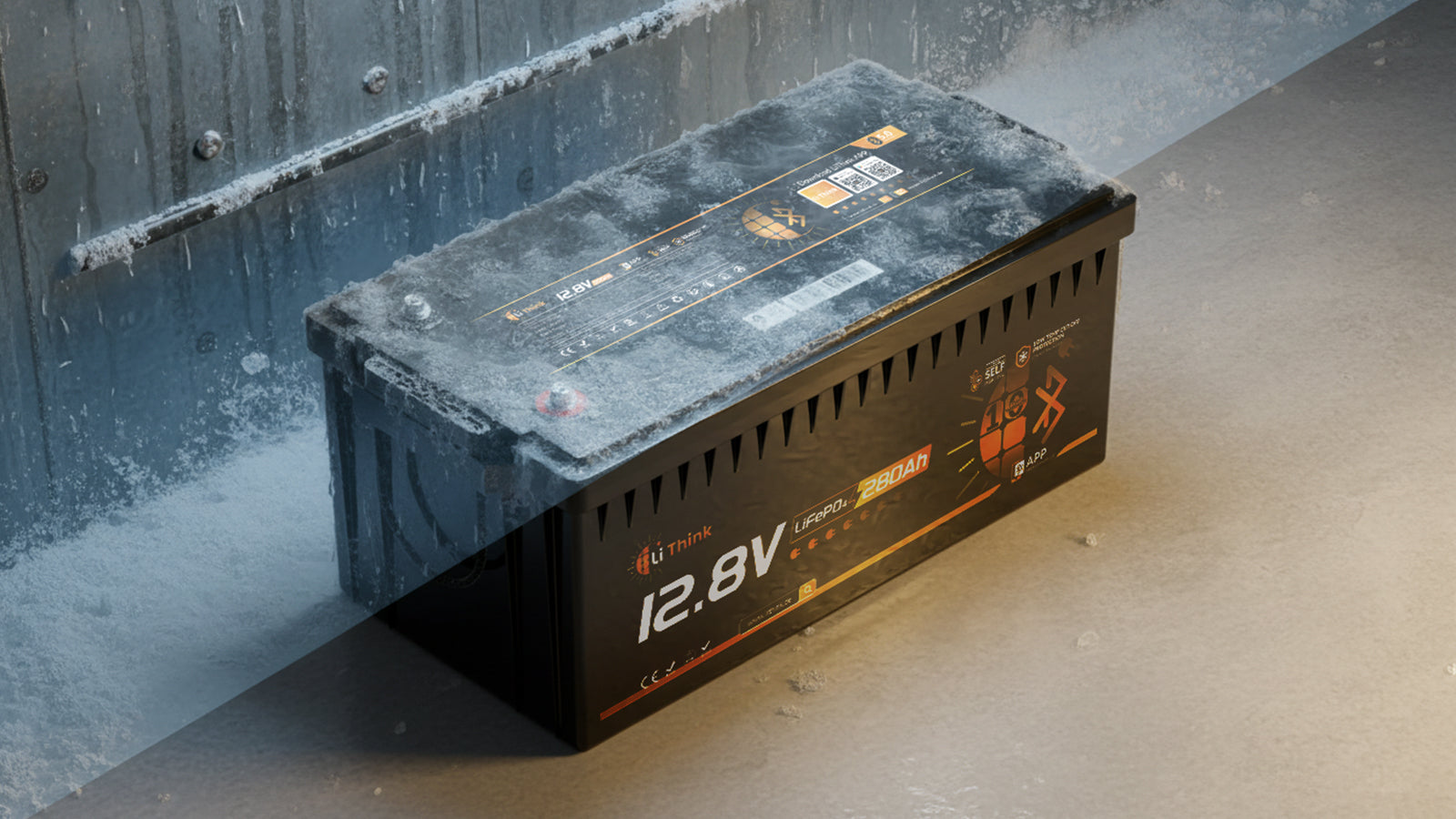
How temperature affects capacity, internal resistance, and voltage
Table of Contents
LiFePO4 batteries are one of the leading battery technologies of our time, and their performance is closely related to temperature. Whether used in marine motors, RVs, or solar systems, temperature affects their capacity, internal resistance, and voltage in many ways.
Today, we analyze the temperature behavior of lithium iron phosphate batteries in detail based on three samples and derive practical recommendations for optimal operation.
1. Temperature Effect on Battery Capacity

At low temperatures, battery capacity decreases extremely quickly, while it increases more slowly at temperatures above room temperature. At -40°C, the capacity is only about one third of the rated value. Between 0°C and 60°C, the capacity increases from 80% to 110% of the rated capacity.
Critical transition points in the low-temperature range:
- At 0°C: 80.2% of the capacity at room temperature
- At -10°C: Reduced to 66.4%
- At -20°C: Only 44.1% remaining
Key Findings:
• The decrease rate at -20°C (15.6%) is twice as high as at -15°C (7.3%) - therefore -20°C is considered a critical threshold for LiFePO4 batteries.
• Charging and discharging capacity increases by only 10 percent at room temperature.
• Above 50°C, capacity decreases again - at 60°C, it is equal to the capacity at room temperature.
After 20 hours of storage at different temperatures and discharge at 0.3C:

- At -20°C: Only 55% of the capacity at room temperature
- At 55°C: Slight increase in capacity compared with 25°C
Optimal Operating Temperature
Based on the data from all samples: 0°C to 50°C is the optimal temperature range for maximum capacity and long service life.
Temperature Effect on Capacity - Summary
| Temperature Range | Capacity Behavior | Recommendation |
|---|---|---|
| < -20°C | Extreme capacity loss (<50%) | Avoid |
| -20°C to 0°C | Significant capacity loss (44-80%) | Use heating |
| 0°C to 25°C | Slight increase (80-100%) | Ideal |
| 25°C to 50°C | Maximum capacity (100-110%) | Optimal |
| > 50°C | Capacity decline | Cooling required |
2. Temperature Effect on Internal Resistance
 Curves of ohmic internal resistance during battery charging for each SOC value at three temperatures
  Internal resistance curves of battery charging polarization corresponding to each SOC value at three temperatures
 Curves of total internal resistance during battery charging corresponding to each SOC value at three temperatures
 Curves of ohmic internal resistance of the battery during discharge corresponding to each SOC value at three temperatures
 Discharge polarization internal resistance curves of cells corresponding to each SOC value at three temperatures
 Curves of total internal resistance of discharged batteries corresponding to each SOC value at three temperatures
• Over a wide SOC range (0.3-1.0), internal resistance remains stable at a constant temperature
• At low SOC (<0.1), resistance increases dramatically
• Polarization resistance increases faster than ohmic resistance
As temperature decreases, both ohmic and polarization resistance increase. However, ohmic resistance is more temperature-sensitive because it mainly depends on the ionic conductivity of the electrolyte, which decreases in cold conditions.
• The change in resistance is more pronounced at low temperatures
• At 25°C, the behavior is more similar to that at 40°C than at 10°C
• The lower the temperature, the more strongly the resistance increases as SOC decreases
• Ohmic resistance increases more strongly than polarization resistance as temperature decreases
• Below 0°C, total resistance increases significantly more
• At temperatures above 0°C, ohmic resistance is independent of SOC
Key Finding: Resistance Composition
Ohmic resistance dominates total resistance and can account for up to 92.13%. Therefore, reducing ohmic resistance is critical for reducing heat generation.
Internal Resistance and Temperature - Summary
| Parameter | Temperature Effect | Practical Implication |
|---|---|---|
| Ohmic resistance | Highest temperature sensitivity | Main cause of heat generation |
| Polarization resistance | Lower temperature sensitivity | Increases earlier at low SOC |
| Total resistance | Increases exponentially in cold conditions | Critical below -5°C |
| Optimal SOC range | 0.2-0.8 for stable resistance | Maintain for best performance |
3. Temperature Effect on Open-Circuit Voltage (OCV)
The open-circuit voltage (OCV) of LiFePO4 batteries increases with increasing SOC, but remains relatively flat in the middle SOC range (0.3-1.0). Below SOC 0.3, the voltage drops sharply.
• The OCV curves for charging and discharging processes differ slightly
• After a rest period, the voltage approaches the actual OCV value
• Lower temperatures generally result in lower OCV curves
Thermodynamic Basics
OCV is determined by the Nernst equation and depends on the standard EMF, thermodynamic temperature, and concentration of the reactants. In the range of 10-40°C, OCV differences are minimal.
OCV and Temperature - Summary
| Factor | Effect on OCV | Remarks |
|---|---|---|
| Temperature (10-40°C) | Low | Differences often negligible |
| SOC | Main determining factor | Stable in the middle range (0.3-0.8) |
| Temperature <10°C | More noticeable effect | Deviations increase |
| Charge/discharge history | Slight differences | Can be balanced by relaxation |
Summary & Recommendations
Key Findings from the Analysis
1. Optimal temperature range: 0°C to 50°C
2. Cold-temperature effect:
- -20°C is the critical point for drastic performance losses
- Significant capacity loss and sharply increased internal resistance
3. Heat effect:
- Above 50°C, long-term capacity loss may occur
4. Internal resistance:
- Ohmic resistance is the most temperature-sensitive
- At low temperatures and low SOC, resistance increases sharply
- For efficient operation, keep SOC between 0.2 and 0.8
5. Open-circuit voltage (OCV):
- Primarily determined by SOC
- Most stable in the middle SOC range
- Temperature has only a small effect (10-40°C)
Practical Recommendations for Users
- Use temperature management systems (heating/cooling) in extreme environments
- Avoid deep discharge, especially at low temperatures
- Keep the SOC range between 20% and 80% for optimal performance
- Monitor the battery temperature in real time for demanding applications
- Allow batteries to rest sufficiently after charging/discharging to obtain accurate OCV measurements
LiFePO4 batteries offer excellent performance for drive and storage applications thanks to their high safety and long service life. Understanding their temperature characteristics enables scientifically informed handling that extends service life and improves efficiency.
Share:
LiFePO4 Battery for Home: Safe, Long-Lasting & Ideal for Solar Systems
Series and Parallel Connection of LiFePO4 Batteries: What You Need to Know