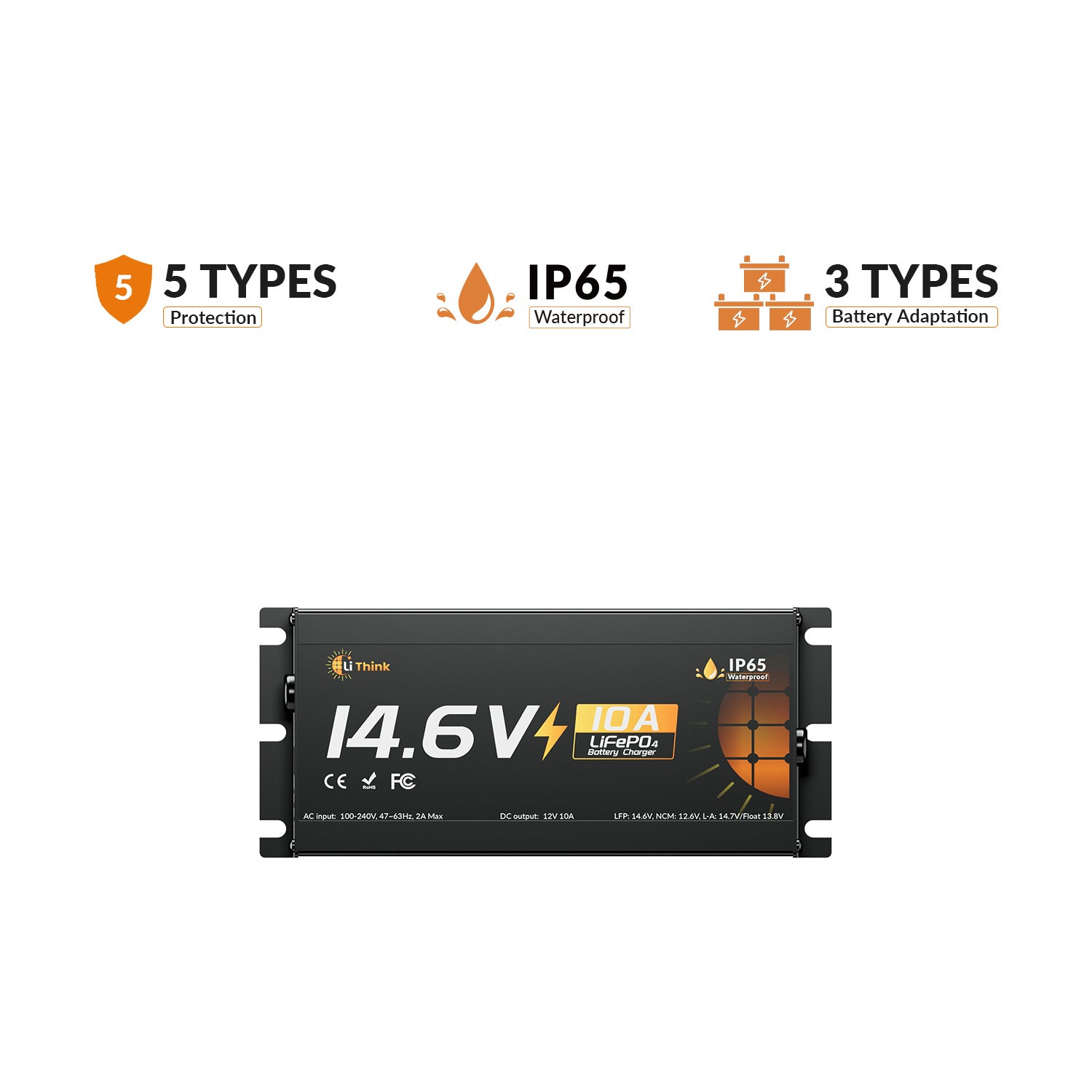
14.6V 10A Charger

  • 0 V Activation

    Wakes protected batteries.

  • CC Fast Charge

    High-current charging to 90%.

  • CV Full Charge

    Stable voltage to finish charging.

  • Auto Shutoff

    Stops when the battery is full.

CONTROLLED. STABLE. SAFE.

5-Layer Smart Protection

The charger monitors voltage, current, polarity, short circuits, and temperature in real time — helping protect your battery and charger during every charge.

  • > 14,6 V

    Overvoltage Protection
  • 10 A

    Overcurrent Protection
  • Auto-Stop

    Short-Circuit Protection
  • + / -

    Reverse Polarity Protection
  • ≥ 75 °C

    Overtemperature Protection

UNIVERSAL BATTERY COMPATIBILITY

3 Charging Modes. One Smarter Charger.

Switch between LiFePO4, SLA/AGM, and NCM charging profiles to match your battery type and keep voltage within the right range.

LiFePO₄ • 14,6 V

SLA / AGM • 14,7 V

NCM Li-Ion • 12,6 V

Built Tough. Easy to Mount.

Designed for everyday charging in garages, RV setups, workshops, and marine spaces — with a durable aluminum housing, efficient cooling fins, secure connector options, and a clean wall-mount installation.

Specifications & What's Included

Basic Electrical Specifications
Input voltage range

100–240V 50-60Hz

Output voltage

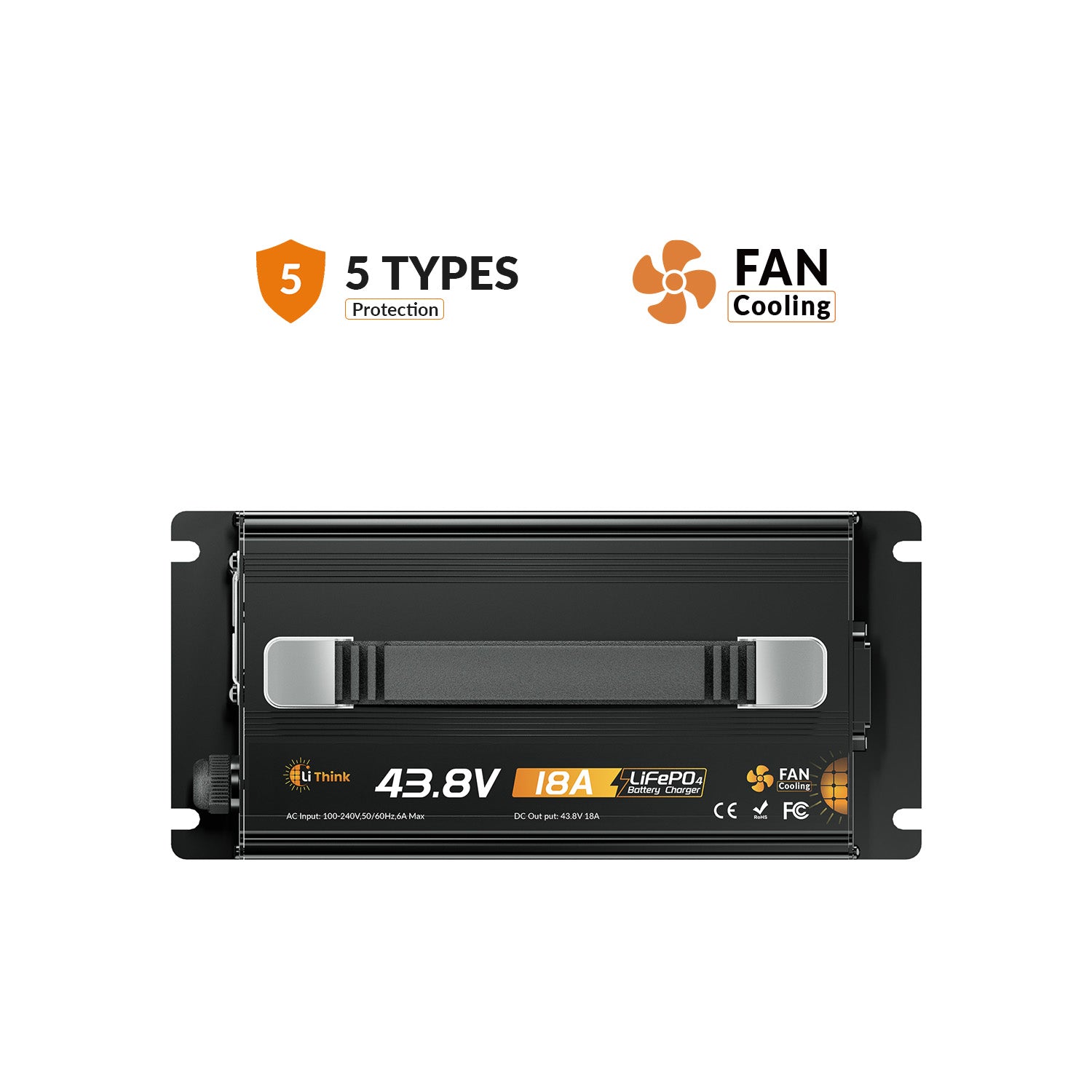
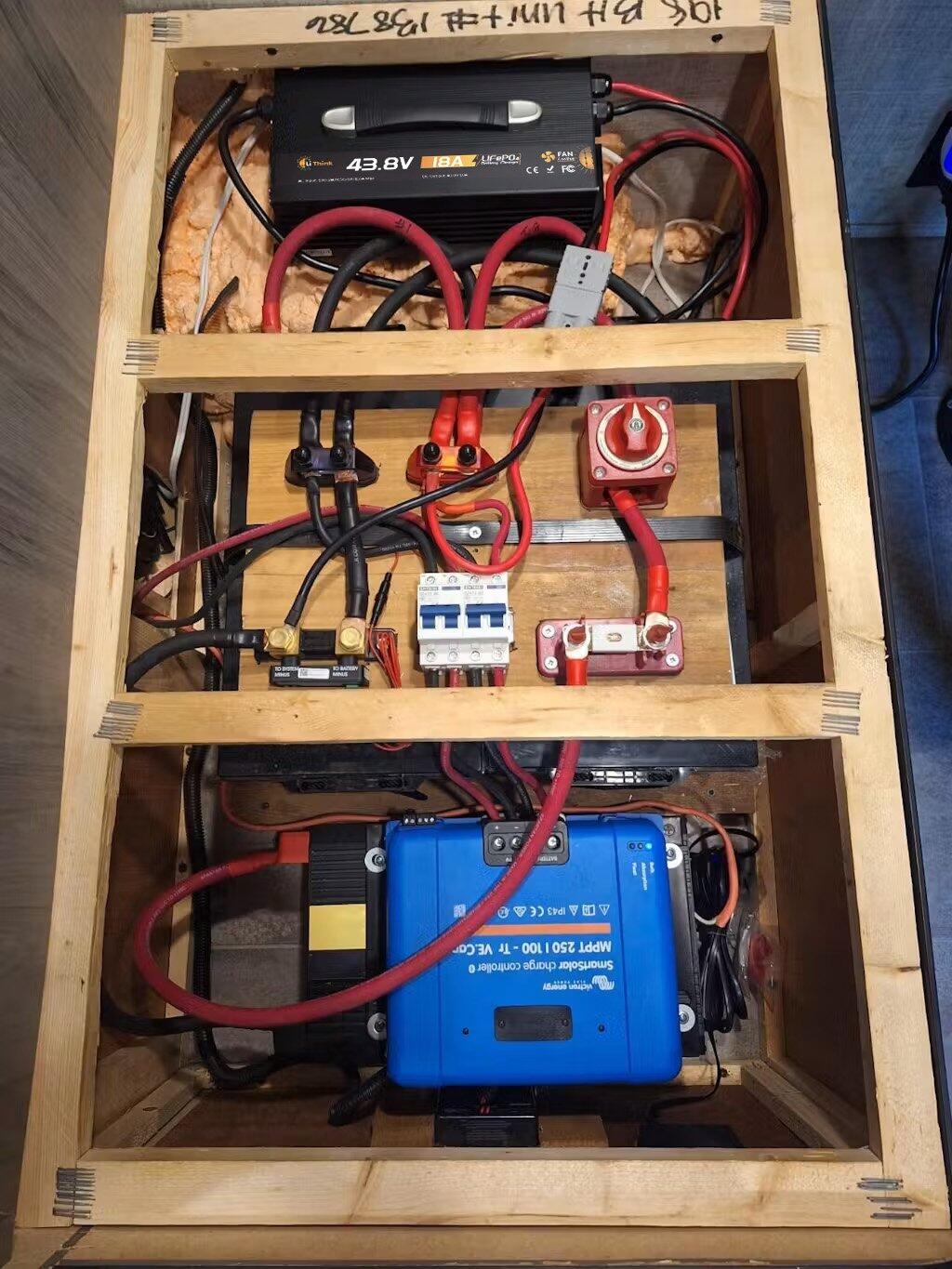
43.8 V

Output current

18 A

Output power

788 W

Charging profile

CC-CV

Compatible battery types

LiFePO4

Safety & Protection Features
Overvoltage protection

Overcurrent protection

Reverse polarity protection

Short circuit protection

Overtemperature protection

Certifications

FCC, RoHS, CE

Mechanical & Structural Specifications
Cooling method

Fan-cooled

Protection class

IP30

Operating temperature range

-4°F to 122°F / -20°C to 50°C

Housing material

Aluminum Alloy

Dimensions l w h

8.66 × 4.72 × 2.75 in / 220 × 120 × 70 mm

Weight

5.51 lb / 2.5 kg

Output connector

Anderson 50 A

Cable length

Input cable: 59.0 in / 1.5 m · Output cable: 43.3 in / 1.1 m · Extension cable: 9.8 in / 0.25 m

Included in the package

  • Wasserdicht

  • Handbuch (DE/EN)

  • Anderson-Steckerkabel

FAQs

1. Which Lithink LiFePO4 batteries is this 14.6V 10A charger compatible with, and what capacities are recommended?

This 14.6V 10A single-port charger is compatible with all 12.8V Lithink lithium iron phosphate batteries, including common sizes such as 50Ah and 100Ah, as well as even larger capacities. It operates most efficiently when charging batteries with a capacity of approximately 30Ah to 120Ah. For example, it takes about 10 hours to charge a Lithink 12.8V 100Ah battery from empty to full. Even larger batteries (e.g., 200Ah) can be charged safely, although the total charging time increases accordingly for higher capacities.

2. How long does it take to fully charge Lithink lithium iron phosphate batteries of various capacities using the 14.6V 10A charger?

The charging time depends on the battery's capacity. Rule of thumb: With a 10A charging current, approximately 10Ah is charged into the battery per hour. For example, it takes about 5 hours to fully charge a Lithink 12.8V 50Ah LiFePO4 battery, while a 100Ah battery takes around 10 hours to reach a full charge. Even larger batteries (such as 200Ah) require correspondingly more time (a 200Ah battery takes about 20 hours to fully charge). The actual charging time may vary slightly depending on temperature and the battery’s initial state of charge, but in general, this charger charges various Lithink batteries very efficiently at a constant 10A.

3. Is the 14.6V-10A charger safe to use? Does it have protective features against short circuits, overheating, etc.?

Yes. This charger was designed with multiple safety mechanisms and is very safe to use. It features built-in safety functions such as over-temperature protection, output short-circuit protection, overvoltage protection, and reverse polarity protection (protection against reversed connections). If any irregularities occur, the device automatically limits or interrupts the charging current to protect itself and the battery. The robust aluminum alloy housing ensures good heat dissipation and durability, and the intelligent 3-stage charging algorithm prevents overcharging. In summary, when used correctly, the Lithink 10A charger is safe and reliable and effectively protects against short circuits, overheating, and other potential issues.

4. How can I tell when the battery is fully charged? Does the charger turn off automatically once charging is complete?

The Lithink charger features a clearly visible LED indicator that shows the charging status. During charging, the indicator glows red continuously, and once the battery is fully charged, the LED turns green. The charger uses a constant-voltage phase at the end of the charging cycle: When the battery is nearly full, the charging current is gradually reduced, and once the battery is full, the device automatically cuts off the output voltage to prevent overcharging. So as soon as the LED switches from red to green, the battery is full and the charger has automatically completed the charging process. You don’t need to worry about overcharging—the charger and the battery’s protective electronics ensure that the charging process is safely terminated when the battery is fully charged.

5. Can this 10A charger charge multiple batteries at the same time? Is it possible to charge two batteries in parallel with this device?

As a general rule, it is recommended to charge only one 12.8V battery at a time with the 14.6V-10A single-battery charger. However, if necessary, two identical Lithink batteries can be connected in parallel and charged together—the charger will then treat them as a single battery with a larger capacity and charge them together. It is important to ensure that the batteries are of the same type and have a similar voltage level before charging to ensure even charging. Note that the charger’s 10A current is divided between the batteries connected in parallel; charging two batteries simultaneously does not double the charging current. The total time required to fully charge both batteries is approximately equal to the sum of the individual charging times, so it is not significantly faster than charging them one after the other. For optimal results and maximum safety, Lithink recommends using a dual charger or a charger with multiple outputs to charge several batteries simultaneously, each at a separate connection. When charging in parallel, be sure to follow the precautions mentioned (identical batteries, same state of charge, secure connections) and monitor the charging process closely.