




Table of Contents
For users of trolling motors, electric outboard motors, or marine LiFePO₄ batteries, high operating currents, frequent starts and stops, and exposure to moisture are part of everyday use. Battery connections and cables are continuously exposed to vibration, salt spray, and humidity. If electrical connections are not installed correctly, the result may range from reduced motor performance and shorter operating range to overheated battery terminals, damaged cable insulation, or more serious safety issues.
This article explains in detail why battery connections can become warm, how to choose the correct cables and cable lugs, why professional crimp connections are generally preferable to soldered connections in high-current systems, and how to check after installation whether all electrical connections have been made safely and correctly.
Is It Normal for Battery Terminals to Get Warm?
A slight increase in temperature at battery terminals or cables during high-current operation does not automatically mean that there is a problem with the system.
Every electrical conductor generates heat when current flows through it. Especially during extended operation at a high motor setting, a slight increase in temperature in battery cables and connection points can be expected. However, if only one specific point becomes unusually hot, this usually indicates increased electrical resistance at that location.
General rule: A slight and relatively even increase in temperature may occur under high load. However, if one battery terminal, cable lug, or fuse holder becomes significantly hotter than the others, it should be inspected.
When Should the System No Longer Be Operated Under High Load?
If any of the following conditions occur, operation at high power should be stopped. Instead, the entire connection system should be inspected as soon as possible.
| Observation | Possible Cause |
|---|---|
| One battery terminal is significantly warmer than the other connections | Localized contact problem, insufficient crimping, or a loose bolted connection |
| The entire cable becomes noticeably warm | The cable gauge may be too small or the load current may be too high |
| The heat-shrink tubing is deformed or discolored | The connection point has already been exposed to excessive heat |
| The motor noticeably loses power at the highest speed setting | Possible voltage drop in the wiring or insufficient power supply |
| The battery BMS occasionally enters protection mode | Possible overcurrent, short-circuit, or undervoltage protection, or a disturbance caused by a poor electrical connection |
| A burnt smell is noticeable near a connection | The system must be switched off immediately and fully inspected |
Common Causes of Warm Battery Terminals
Battery connection heating is often not caused by a single factor. Cables, cable lugs, crimp connections, installation quality, and environmental conditions all affect electrical resistance. The following problems are particularly common in marine battery systems.
1. Low-Quality or Incorrect Cable Lugs
A cable lug, also known as a tubular cable lug, ring terminal, or cable lug, connects the battery cable to the battery terminal. One end surrounds the stripped copper conductor and is crimped onto the cable. The other end consists of a flat terminal with a hole, which is secured by a bolt to the battery terminal, busbar, or circuit breaker.
Many cable lugs look similar from the outside but can differ significantly in material thickness and manufacturing quality. High-quality cable lugs are made from sufficiently thick copper, have reliable wall thickness, and feature a wide contact surface. This provides a larger contact area with the battery terminal. Lower-quality cable lugs may have thin walls, narrow contact surfaces, poorly manufactured holes, or internal contamination from oil residue and uneven surface treatment.
2. Poor Crimping and Loose Internal Contact
With a crimp connection, it is essential that the copper strands inside the cable lug make firm and extensive contact with the lug itself.
A properly made crimp creates a dense connection with as few air gaps as possible between the copper conductor and the cable lug barrel. This allows current to flow through a large contact area, keeping electrical resistance low and minimizing heat generation. If the crimping force is insufficient or the crimp die does not match the cable lug, the outside of the lug may appear properly compressed while the copper strands inside remain loose. Such a connection may appear to work at low currents but can begin to overheat under high load.
3. Cable Gauge Is Too Small
The required cable size depends on the maximum current, cable length, and acceptable voltage drop.
The thinner the cable, the higher its electrical resistance. Resistance also increases as cable length increases. When a high current flows through a cable that is too thin or unnecessarily long, significant voltage drop and heat buildup can occur. Voltage drop reduces the actual voltage reaching the trolling motor, which can lead to lower performance, reduced efficiency, or problems with the motor controller.
Important for 12V systems: For the same power output, a 12V system carries significantly more current than a 24V or 36V system. To deliver more than one thousand watts of power, a 12V system must therefore handle much higher current. For this reason, 12V trolling motor systems are especially sensitive to undersized cables and poorly made electrical connections.
4. Bolted Connections Are Not Tightened Correctly
Bolt tightness directly affects the contact area and contact pressure between the cable lug and battery terminal.
If a bolt is too loose, the actual conductive contact area becomes smaller. Under high current, the connection can become very hot locally. Boats also experience continuous vibration. A connection that was only marginally tight during installation may therefore loosen further over time.
However, bolts should not simply be tightened as much as possible. Excessive tightening can damage the battery terminal, threads, or cable lug and may reduce long-term reliability. During installation, always follow the specifications in the battery manual or the recommended torque values for the specific terminal type.
5. Oxidation, Oil, Moisture, or Salt on the Contact Surface
A reliable electrical connection requires clean, dry, and flat contact surfaces. Oxidation, grease, dust, water, or salt on cable lugs, battery terminals, and busbars can increase contact resistance.
This problem occurs more frequently in marine environments than in dry indoor conditions. Moisture, salt spray, and condensation accelerate corrosion on metal surfaces. Adhesive-lined heat-shrink tubing, protective battery terminal covers, and properly protected cable routing can significantly reduce the risk of corrosion over time.
How Can You Troubleshoot the Cause Step by Step?
If battery terminals or other electrical connection points become noticeably warm, operation under high load should not continue. The system can be checked in the following order.
- Turn off the trolling motor and all connected loads: Connections must not be removed while the system is under load or energized. Wait until all terminals have cooled completely.
- Identify the location of the heat source: Check whether the battery terminal, the crimp area of the cable lug, the entire cable, the fuse holder, the circuit breaker, or a connector is becoming warm.
- Compare the temperature of the positive and negative cables: If the positive side is noticeably warmer, inspect the positive current path carefully. If the negative side is warmer, the return path must also be inspected.
- Check all bolted connections: Inspect battery terminals, fuse holders, circuit breakers, and busbars. Loose bolts are among the most common causes of problems in high-current electrical systems.
- Inspect cable lugs and contact surfaces: Look for discoloration, oxidation, deformed terminal surfaces, incorrect hole diameters, or contact surfaces that do not sit completely flat. Oxidized, dirty, or wet surfaces must be cleaned before the connection is reassembled.
- Inspect the crimp connection: Check whether the barrel is evenly compressed, whether the cable can move inside the lug, whether copper strands are visible, or whether the heat-shrink tubing has become deformed. If a faulty crimp is suspected, the cable assembly should be remade completely.
- Reassess cable gauge and cable length: If the entire cable becomes warm or there is a noticeable voltage drop at the highest motor setting, check whether the cable size is sufficient for the actual current and cable length.
- Perform a load test: After reassembly, operate the motor at a low setting first. The load can then be increased gradually. After operating for a period of time, compare the temperatures of all connection points. If one point remains significantly warmer than the others, the underlying cause has not yet been resolved.
Recommended measuring tool: If possible, use a thermal imaging camera or infrared thermometer. A thermal camera makes localized hot spots especially easy and quick to identify.
How Can Overheating at Trolling Motor Connections Be Prevented?
The most important way to prevent overheated electrical connections is to minimize contact resistance and ensure that the entire current path can safely carry the maximum operating current.
Use pure copper cable with the correct gauge: Cable size should be determined based on the motor's maximum current, system voltage, and the distance between the battery and motor. As cable length increases, a larger conductor size is often required. Copper-clad aluminum cables should not be used for high-current marine applications.
Use high-quality cable lugs: Tinned copper cable lugs are recommended for marine applications. The tin coating provides better protection against oxidation and corrosion in humid environments. The cable lug, cable size, and terminal hole diameter must all match correctly.
Use proper crimping techniques: High-current cables should not simply be compressed with ordinary pliers. A soldered connection should also not be used as a replacement for a mechanical crimp. A properly made crimp provides a durable, mechanically strong, low-resistance connection between the copper conductor and the cable lug.
Use adhesive-lined heat-shrink tubing: Heat-shrink tubing with internal adhesive helps prevent moisture ingress, improves corrosion protection, and provides additional mechanical protection for the crimp connection.
Tighten terminals to the specified torque: Battery terminals should neither be left loose nor overtightened without reference to the manufacturer's specifications. Follow the recommended torque values in the user manual. It is also advisable to inspect the connections again after the first few uses.
Route and secure cables correctly: Heavy cables should not place continuous mechanical stress on the battery terminals. Cables need additional support points so that vibration and boat movement are not transferred directly to the battery terminal. Sufficient cable bend radius should also be maintained.
Carry out regular inspections: Moisture and vibration continuously affect marine battery systems. Even a properly installed connection can loosen or corrode over time. Important electrical connections should be inspected before the start of each fishing season, before long trips, and whenever unusual performance loss occurs.
Lithink Recommendation for Trolling Motor Batteries
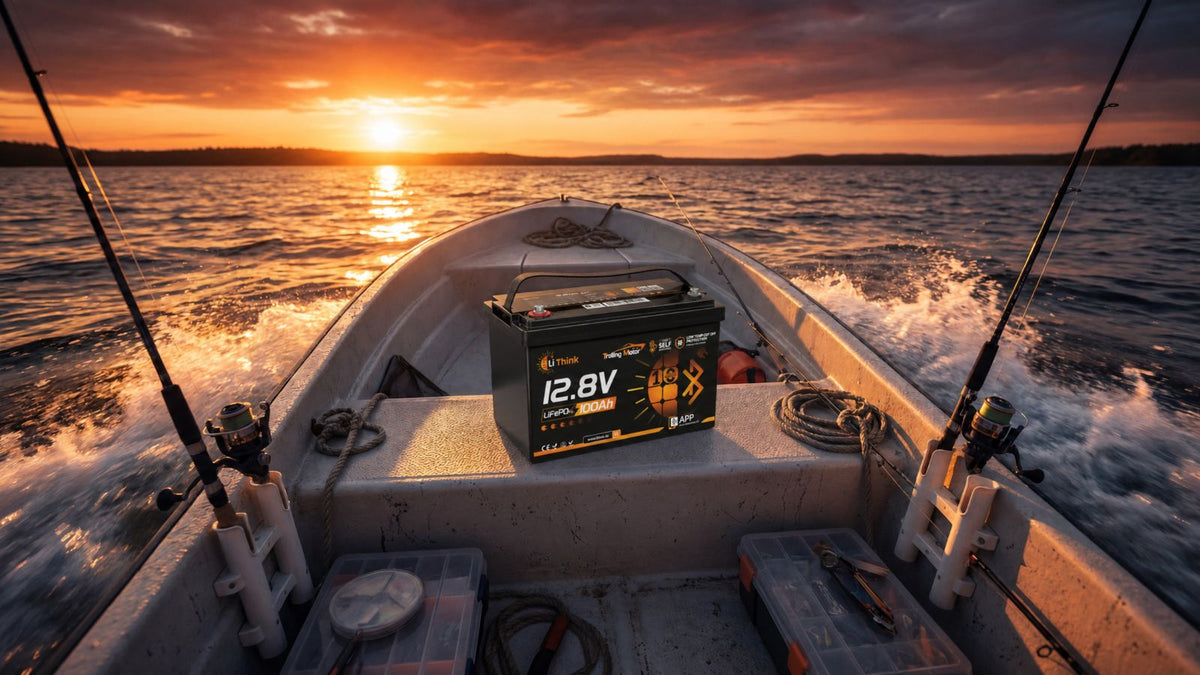
If you are looking for a lightweight yet high-performance marine LiFePO₄ battery for your trolling motor, the Lithink TM LiFePO4 Battery is designed for this type of application. It offers a capacity of 12V 100Ah and is suitable for common 12V trolling motor systems. The battery can provide reliable power for fishing boats, inflatable boats, smaller watercraft, and other onboard electrical equipment.
Compared with conventional lead-acid batteries, it offers lower weight, more stable voltage, and a longer cycle life. This makes it particularly suitable for applications involving extended operation at low speeds, frequent starting and stopping, and high demands for efficient power delivery.
Bluetooth monitoring: The app allows users to monitor the battery's state of charge, voltage, current, temperature, and operating status. This makes it easier to assess battery condition before departure and during operation.
Advantage in marine applications: Real-time monitoring can help identify unusual loads, voltage drops, or abnormal temperature changes at an early stage. This can improve both operating convenience and safety during use.
Conclusion
A slight increase in temperature can occur during operation. However, significant overheating should always be investigated. To ensure that a trolling motor delivers stable performance over the long term, voltage drop remains low, and the electrical system operates safely, no high-current connection should be overlooked.
Even a high-performance battery requires a properly installed and reliable connection system. Cable size, cable lugs, crimp connections, bolted connections, corrosion protection, and regular inspections should therefore be treated as parts of one complete electrical system.
```


Share:
LiFePO4: Is a Larger Cell Voltage Difference During Charging Normal?
What Battery Do You Need for a 55lb, 70lb or 80lb Trolling Motor?